
Wherever you live as a homesteader, and whatever you’re doing on your homestead, it’s only a matter of time until you’ve got to deal with unwanted pests. One of the most persistent, destructive, and paradoxically cutest pests around is the raccoon.
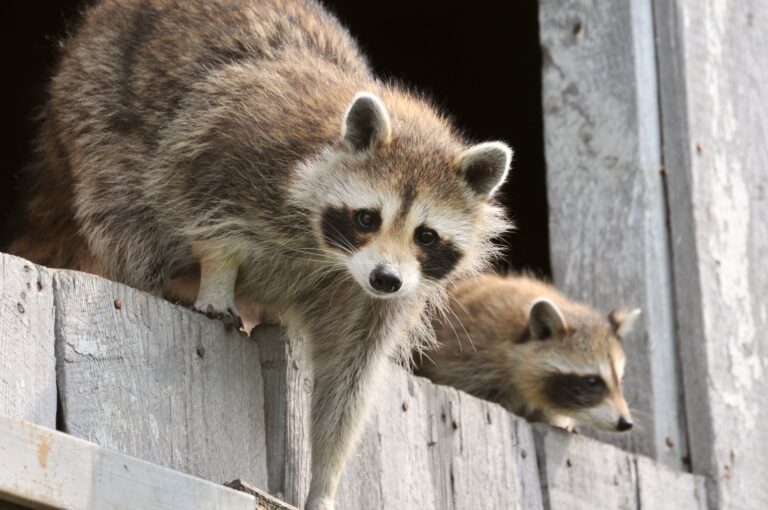
Who could stay mad at one of these charismatic little critters? Those black masks, those ringed tails, and those little hands! They are great fun to watch on the internet or out in nature, but if you let them settle in on your property, you’ll have no shortage of trouble.
Stolen trash, dead or injured animals, and maybe even a raccoon living in your attic or soffits; all that and more await you! Happily, you don’t have to kill the cute little things in a trap to get rid of them. It’s possible to keep them away using other means. Keep reading and I’ll give you 11 tips to do just that.
Secure Your Trash
The first, best, and most important tip I can give you. Nothing, and I mean nothing, attracts raccoons to your property and invites them to stick around like an all-you-can-eat and easily accessible trash buffet.
Raccoons are excellent climbers, highly intelligent, and very dexterous, and that means they can easily scamper up your trash can, lift the lid, and then tear into your bags, making a huge mess as they go.
The best thing you can do to keep them out is to invest in a heavy-duty trash can that has a raccoon-proof latching lid or a provision for putting a simple locking device on it. Also, make sure your trash is tied up tightly to help prevent odors from getting out and attracting them in the first place.
Lock Up Your Compost Pile
On a similar note, if you make your own compost, and you should, it is also likely to attract raccoons, at least during the early stages of decomposition.
Kitchen scraps are solid gold for any good compost pile, but the smell of such organic matter, even if you keep the pile turned, will be a raccoon magnet. It’s got an even higher chance of doing so if you put dog or cat manure in there.
There’s not much you can do about this in terms of sealing it off. Compost piles need plenty of ventilation. You can, though, make sure the bin or pile itself is enclosed in such a way that raccoons can’t get to it, and you can put a heavy latching lid over the top. That will keep raccoons from getting into it and making a giant mess.
Eliminate Easy Food and Water Sources
This is an easy one to forget if you’ve got pets, and a tip that’s easier said than done if you’ve got other animals. Raccoons are relentless, reprobate thieves, and they love nothing more than getting an easy meal. The easiest meal around is a bowl of dog or cat food left out right next to a big bowl of water.
If that’s not an option, they will happily steal chicken, goat, horse, and other kinds of animal feed.
Wherever possible, keep food securely contained or disposed of. Make it a point to only feed your animals the right amount of food at prescribed times to eliminate leftovers.
Secure Any Animals That Are Prey to Raccoons
It’s not just your animals’ food that is also food for raccoons; the animals themselves might serve as prey for them!
Raccoons are among the most notorious predators of chickens in domestic settings. They are more than capable of dispatching adult chickens, and they’ll make short work of chicks and eggs. The same goes for most duck breeds.
Fish in small ponds, like koi or goldfish, are also on the menu. There’s not much you can do to truly conceal the presence of your animals from raccoons, but you can prevent deaths, and discourage repeat visits, by keeping your vulnerable animals in secure shelters with raccoon-proof latches.
Keep Your Property Clean and Tidy
As a general rule of thumb, pest animals are more likely to hang around on disorderly, overgrown properties. Places with less activity and more cover say “move on in” to raccoons.
If your property is due for a good spring cleaning, and your buildings a good scrubbing, now’s the time to do it. This is especially important concerning animal waste and odor, as both will readily attract these little bandits.
Close Up Access Points on All Buildings, Porches, and Decks
You never, ever want a raccoon to get in your house or live near it! Ask me how I know.
But again, accomplishing this is easier said than done. You’ve got to make sure attic vents, eaves, soffits, porches, decks, and patios are all absolutely secured against the intrusion of raccoons, along with your sheds, animal shelters, and any other structures.
Use sturdy wood and good fasteners, and don’t be afraid to close off smaller passages with hardware cloth or something similar. Make sure the openings on anything you use for this purpose are small, no more than 3 ½ inches square. Raccoons look huge, but it’s mostly fur; they can squeeze into little spaces!
Install Motion-Activated Lights
Just like human burglars, raccoons prefer to operate in the dark, where they feel safer and more secure. Motion-activated lights on buildings, or even freestanding ones, can spotlight them and make them hesitant about continuing. They’re worth setting up as another layer in your deterrent strategy if you can do so conveniently.
Be warned, though, that this works best in conjunction with other strategies, because raccoons quickly adapt to such things if there are no consequences.
Try Motion-Activated Sprinklers
One of my favorite methods for running off raccoons is to use motion-activated sprinkler systems. They are just what they sound like; when the sprinkler detects movement, usually through an infrared sensor but sometimes through a laser, it turns on and showers everything nearby with water. Some of them even automatically aim at the trespasser like a water gun!
The resulting noise, movement, and shock of getting suddenly wet is a strong deterrent to raccoons. But raccoons are bold and will endure discomfort and a certain amount of fear to get food, so this strategy might not prove effective on its own.
Scatter Cayenne Pepper, Garlic, or Peppermint
Like so many animals in nature, raccoons have incredibly sensitive olfactory organs. Despite their preference for garbage, tuna, and other stinky foods, there are some things they simply cannot tolerate.
Things like cayenne pepper, peppermint and garlic, and more can be scattered around periodically, and especially along their usual paths or near entrances, to run them off. Make sure you refresh on a weekly basis, or more often if it rains.Also, keep your own nose perked; if you walk your property where you’ve placed any of the above and don’t smell them, they are weakened and should be replaced.
Try Spraying Predator Urine
Raccoons are pretty low on the totem pole in the animal kingdom, all things considered, and they are very sensitive to any indication that their predators might be near.
If you’re willing to put up with something smelly yourself, predator urine works wonders in my experience. Here’s the trick: find out what predator is most common in your area and then seek out a urine spray. Bobcats, coyotes, wolves, and so forth all work well.
Consider an Ultrasonic Repellent Device
If you exhaust all other possibilities, consider an ultrasonic repellent device. This is a love-it-or-hate-it option, as some people swear by them and others promise they are junk or gimmicks. These things emit a sound at a frequency humans can’t hear, and the nice ones even have a tailorable output so you can set it to affect certain animals and not others, like your dogs or cats, for instance.

Tim is a farm boy with vast experience on homesteads, and with survival and prepping. He lives a self-reliant lifestyle along with his aging mother in a quiet and very conservative little town in Ohio. He teaches folks about security, prepping and self-sufficiency not just through his witty writing, but also in person.
Find out more about Tim and the rest of the crew here.