
If you are a homesteader, you probably already know just how important generators are. And if you don’t, just wait! You’ll find out soon enough…
Whether you are relying on it as your primary source of electricity in the aftermath of a disaster, or just trying to run some power tools at a remote corner of your property, they are indispensable. And if you live entirely off-grid, your generator might actually be your lifeline in some situations.
A big part of using your genny responsibly and safely is in proper placement. Placing and positioning it correctly will make sure that you and anyone else nearby stay safe, and it will also keep it running better, longer.
Poor or botched placement can lead to damage, an accidental fire, or injury, and I know no one wants that!
Below you will find proven guidelines for placing your unit correctly.
Level Ground Is Best
Whatever kind of generator you are placing, be it a portable job site model or a standby version that can power your whole house in the event of the grid going down, you need to put it on a level spot.
Level ground is best for ensuring optimum function. If your unit isn’t kept level it might suffer from vibrations that can accelerate wear, or even fail to properly draw fuel or oil and circulate it into the engine.
It doesn’t need to be perfectly precise, but you don’t want it sitting on a slope or tilted.
Put It on a Slab or Gravel
The ideal surface for your unit is a concrete slab or packed gravel. These surfaces are sturdy enough to withstand the constant vibration and heat, and they also won’t catch fire. In a pinch, you can set a portable one on grass or dry, packed dirt, but it’s not ideal.
Especially if you are installing a whole-house standby generator, make sure you take the time to put a concrete pad in, and check your local or state regulations: they might specify a certain type or thickness of concrete!
Avoid Straw, Mud, and Sand
As a rule, avoid placing your genny, whatever kind it it, on straw, mud, or sand. Dry straw is a major fire hazard, that much should be obvious, but mud is highly abrasive and sand is even worse than that.
Letting this stuff get worked into the nooks and crannies of your generator, even just on the control panel, is only going to accelerate wear and cause malfunction.
If, for whatever reason, you are forced to set it on one of these surfaces, you should moisten it ahead of time in the case of straw or sand to help prevent it from being kicked up.
Also place a piece of plywood or some other sturdy planking down over mud to help minimize mess and prevent the unit from sinking.
When you’re done, make sure you clean the generator thoroughly.
Always Make Sure a Generator Is Placed in a Well-Drained Area
One of the worst things you can let happen is allowing your generator to be submerged in water. This is going to cause serious damage!
For this reason, any location where you place it must be protected from flooding in the short and long term. Portable generators might be easy to move when the water starts to rise, yes, but it’s not something that you want to chance and a flash flood might submerge it before you can react.
Likewise, carefully plan the placement of a standby generator so that it will not be affected by anything except the most severe flooding.
Generators Need Generous Clearance on All Sides for Safety and Maintenance
It’s always a good idea to leave generous clearance on all sides of your unit for safety and ease of maintenance. Portable generators can be quickly and easily repositioned, yes, but not so with fixed standby models.
A good guideline is that you should leave at least three feet of clearance on all sides of the generator for fire prevention, and also to allow plenty of room to get in there and work on it, either servicing it with an oil change or replacing parts as required.
In most places, it’s considered acceptable to leave just 18 inches of clearance between the back side and your home where you site it.
It pays to do a thorough assessment of what is near your generator that might be vulnerable to ignition, especially when it is piping hot because it’s been running for a long time. Consider moving the generator or removing the fire hazard as needed.
Your Generator Should Be at Least 5 Feet from All Doors, Windows, and Intakes
Whether you are running a portable near your home or installing a standby model, make sure you leave at least five feet between the genny and all doors, windows, vents, and other intakes on your home.
All generators that use liquid fuel, be they diesel, propane, gasoline, or something else will emit harmful exhaust gases that can accumulate inside your living space and poison you or your family.
You don’t want that to happen! Accordingly, your best defense aside from keeping your generator properly maintained is to keep it far away from these areas of ingress to stop gas from accumulating inside the home.
Even a marginal amount of gas buildup can cause illness, and if it is running all night while you sleep, a bad leak means you might not wake up again…
Never, Ever Run Your Generator Inside Your Home!
On that note, you must never, and I mean ever, run a generator inside your home for any reason- no matter how dire the situation is.
No matter what you need to power, no matter how badly you need heat or refrigeration, this is a guaranteed death sentence in time.
There’s simply no way to effectively vent the exhaust gases from a running generator that’s inside to the outside without some of it leaking and building up inside your living space.
Every year, we see this problem from people running them in this way or other appliances and tools that emit combustion exhaust, and every single year people die or get terribly sick. You just can’t risk it.
You Can Run Your Generator in a Garage with the Door Up
However, there is one exception, a tenuous one, to the above prohibition against running your genny indoors. You can safely run it inside an attached or detached garage as long as you have the main garage door up to allow for lots and lots of ventilation.
This ensures that there’s virtually no way that gas and the harmful carbon monoxide it contains can accumulate in dangerous levels. However, you’ll still want to position it as far from the door leading into the home as you can in the case of an attached garage.
This can be a convenient option if you need to work on something in the garage or actually get power going to the home with a portable generator and the weather outside is truly gnarly. Just leave that door up and you should be fine.
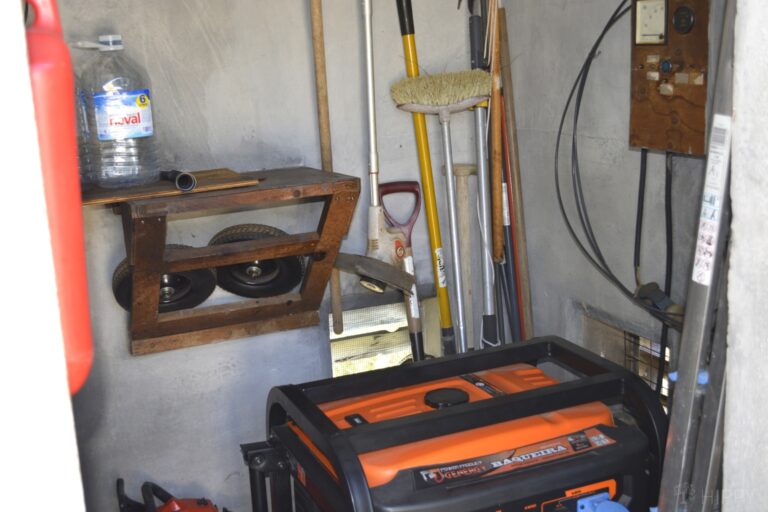
Consider a Generator Shed to Protect Your Generator
All generators should be protected from the weather, and although some light rain or snow might not hurt them in short intervals, it will steadily degrade them over time and in some cases can interfere with function.
If you have a standby unit and live in an area that’s prone to a lot of wet weather or other harsh climatic conditions, or just want to give a portable that you use often maximum protection, build a generator shed for it.
A generator shed is exactly what it sounds like, a small shed that has special attention given to maximum ventilation. This ensures that those aforementioned toxic fumes we’ve been talking about won’t build up inside the little hut.
Even an open-top structure with a sloping roof that will just keep rain and snow off of the unit itself can be worthwhile. It’s also a great time to lay down that concrete pad we talked about up above.
Consider Placing Your Generator So the Noise Will Be Less Bothersome
It’s easy to forget in the midst of all these other factors, but remember that your generator is going to be loud. Extremely loud. If it isn’t a solar generator or a battery bank; it’s going to make a ton of noise. Consider where other people will be, and particularly you and your family if the unit is near your home.
The farther you can place it from the home the better, but you should also try to point the exhaust away from living areas and neighbors, and consider placing obstructions between people and the primary generator location to help block and disperse some of the noise.
If this is impossible or if other factors take precedence, you can build a sound-deflecting enclosure around the generator without risking a fire or damage that will do wonders to reduce the aggravation.

Tom has built and remodeled homes, generated his own electricity, grown his own food and more, all in quest of remaining as independent of society as possible. Now he shares his experiences and hard-earned lessons with readers around the country.
Find out more about the team here.