
f you want a flock of your own, you must provide your birds with a coop. No ifs, ands, or buts. Chickens need a coop that is safe, provides shelter from the elements, and is a comfortable place for them to rest. Without one, they will be stressed, unhappy, and vulnerable.
The trick for chicken keepers, especially brand-new ones, is figuring out what kind is best for them. Even a cursory search will bring up dozens of different designs.
What’s best? How do you determine that? Which one is a good fit for you and your property? It’s enough to make would-be wranglers of yardbirds give up before they ever get started, but don’t despair.
Today, I’m bringing you a quick and clear guide on choosing the right chicken coop and what features to look for. Roll up your sleeves, and we’ll get right into it.
The Bare Necessities of a Good Coop
Before we talk about chicken coop types, it will be helpful to go over what features make a good chicken coop. Any that you consider buying, building, or converting must provide the following:
Space
Chickens, no matter the breed, must have adequate space to themselves. Typical breeds, meaning non-giant and non-bantam, need between 3 and 4 square feet to themselves inside the coop so they can rest comfortably. Make sure it’s spacious enough; you are wise to buy big so you can accommodate a few unexpected additions to your flock!
Predator Security
Chickens are pretty much at the bottom of the food chain. Seemingly everything that slithers, crawls, walks, or flies loves to eat chickens, chicks, or eggs. Accordingly, any coop worth considering needs to be secure. If it doesn’t have a solid attached floor, the walls or wire mesh must extend at least a foot into the ground to discourage digging.
Likewise, the coop should be closed up tightly all around with hardware cloth, leaving no opening larger than an inch for nimble predators like weasels, rats, and the like to sneak in. Also, the door or hatch on the coop must have a secure lock that can withstand dexterous predators like raccoons and possums; they can open simple latches!
Ventilation
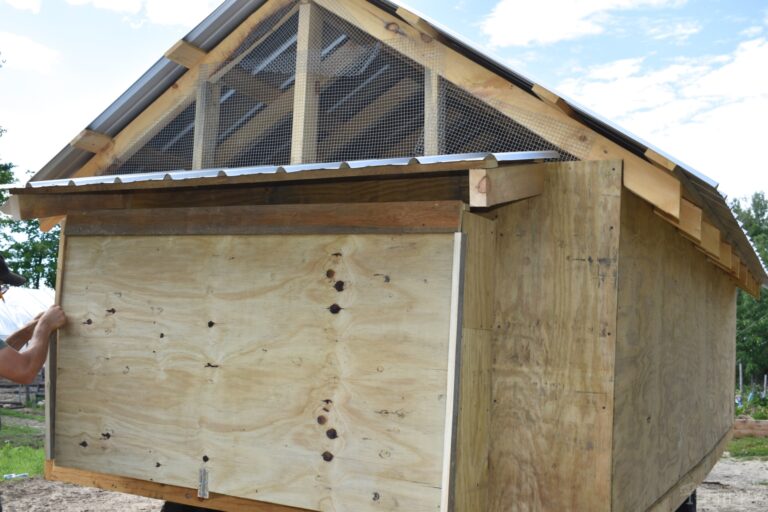
Ventilation is a must. Chicken droppings contain ammonia, and that will build up, potentially dangerously, inside the coop if it’s too stuffy. Aside from being nasty, this can make your birds sick. Roof or ridge vents and one or two wall vents for cross ventilation are generally adequate, but do make sure those openings are protected by the aforementioned hardware cloth.
Roosting Bars
Chickens roost to sleep whenever possible. Roosting bars are needed for their psychological health and comfort. Bars should be roughly 2 inches in diameter, about a foot off the ground, and allow 12 inches of lateral space per adult bird.
Nesting Boxes
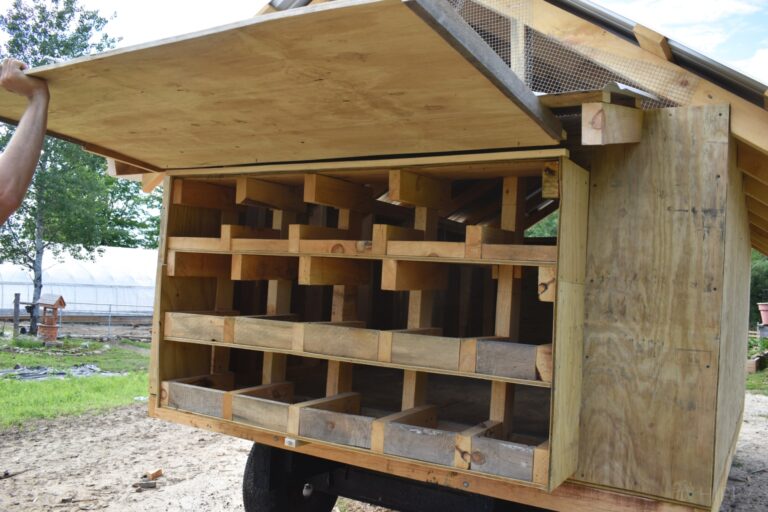
Hens will want to lay their eggs in a comfy, secluded spot, and you can provide this inside the coop with nesting boxes. Nesting boxes should be roughly a foot square, dark, and thickly lined with fresh, soft straw or other chicken-safe bedding.
Note that nesting boxes should ideally be lower than the roosts to discourage your birds from sleeping in them instead of on the roost bars themselves. You’ll need one nesting box for every three to four hens as a rule of thumb.
Chicken Coop Types
The following are design families, for lack of a better word, that describe chicken coops. There are many variations inside each of these families, and as expected, all have pros and cons.
Hen House
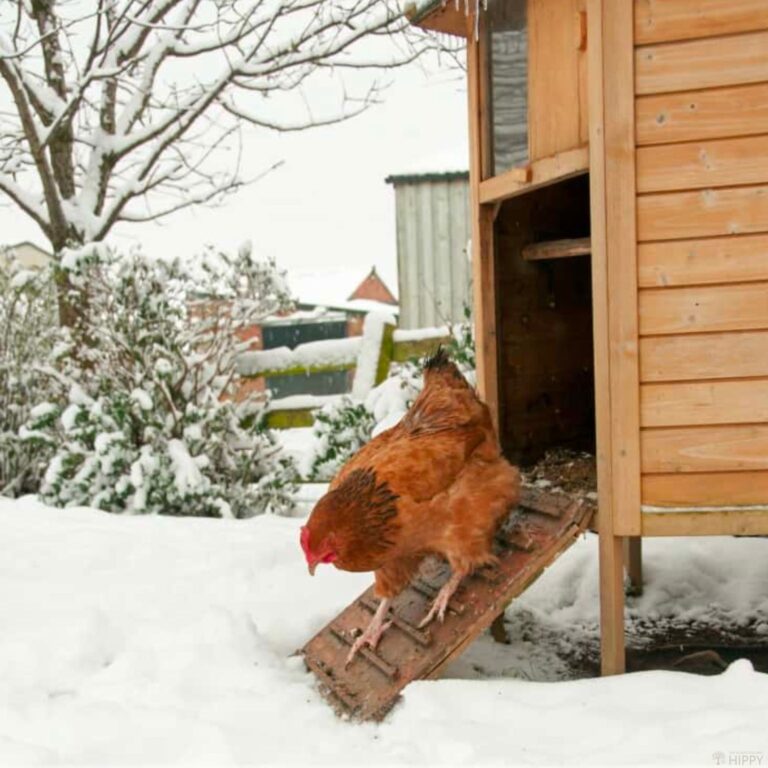
This is the most common and, to many of us, the most iconic type of chicken coop. It looks like a little house with a small door or hatch and often a ramp that the chickens will use to get in and out.
Often, the main room of the house will have one or two smaller attached structures that look a little bit like sheds or extensions; these are actually the spaces for the nesting boxes and often have smaller doors or flip-up roofs that will allow you to easily collect your breakfast without crawling inside the coop.
Adaptable, cute, relatively easy to build, and often affordable if going with an over-the-counter solution, this is the first and sometimes last stop for many chicken keepers.
The biggest downside with a true hen house is that, as a rule, they do not allow you to walk inside when needed. You’ll have to crawl in or lean in awkwardly to clean or repair the structure. These are, though, a great candidate for a removable tray floor that will make the former significantly easier.
A-Frame/Ark
Simple, compact, and ideal for tiny flocks or folks who just want two or three birds. An A-frame coop, sometimes referred to as a chicken ark, looks very much like an A-frame house. It’s basically a triangle with steeply sloped walls or a steeply pitched roof.
Access for birds and their keepers is usually accomplished by one of the roof panels swinging up and away, though sometimes a hatch-style door on either end is used.
Often, A-frame coops are built with a small, fenced run directly beneath them. These are among the most mobile “fixed” coops, as they are usually easy to drag around or pick up and move with a couple of people. If you want to build your own quickly or buy a cheap one, these are a great choice.
The biggest downside is that they are typically very space-limited, and you might outgrow it in a hurry if your flock expands.
Walk-In
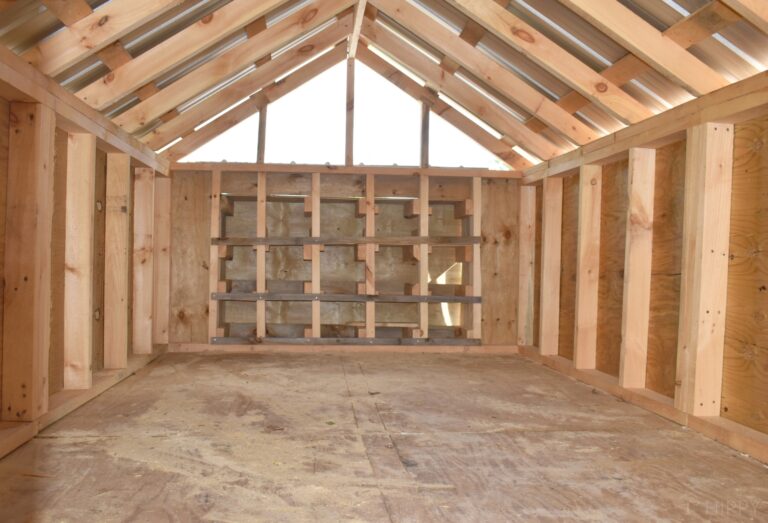
For the ultimate in convenience and ease of working inside it, nothing beats a walk-in. A walk-in coop is exactly what it says on the label: a chicken coop that is tall enough for you to walk in, or sort of walk in, complete with a human-sized door.
Often, these are the de facto coops of folks with larger flocks because they have significantly more interior space. Because they are so much taller, there is more vertical space for more roosting bars, and that means more chickens.
Likewise, nesting boxes are typically elevated off the ground and attached to the outer wall of the structure in a way similar to a hen house. This still provides for easy egg collection if you don’t want to enter the coop and risk a confrontation with a potentially grumpy hen.
These are a great solution for anyone who is raising, or planning on raising, a large flock. The single biggest drawback, naturally, is the fact that a bigger structure means more material and a more complicated build, along with significantly more expense.
However, lots of keepers improvise here and create a walk-in coop from another structure like a shed or similar. We’ll talk more about those in their own category in just one second.
Elevated
Elevated coops are usually a smaller design like an A-frame or a hen house that is propped up on long legs or posts. It is basically a coop on stilts! These coops require a ramp or, less frequently, a ladder and floor hatch for the chickens to get in and out.
These types of coops are popular and recommended in places that stay wet and muddy because they will help keep the inside of the coop clean and avoid it getting waterlogged, which will lead to rot if it’s made of wood. These are also a little bit easier to lean in and clean because you don’t have to stoop down.
However, the big shortcoming with these is that accidents among your birds, entering or exiting, will be more frequent, especially among comparatively clumsy giant breeds. Foot and leg injuries can lame a chicken or get infected, leading to costly care or even death.
Two-Level
A two-level coop is best described as an elevated coop with an enclosed run directly below, or sometimes wrapping around one or two sides with the rest of the enclosure below.
These are wonderful space-saving options for suburban keepers, but they have some complexities you’ll have to deal with. Namely, if you’re building it yourself, building the run won’t be as straightforward as a ground-level coop. Access for the birds is also usually achieved through a floor hatch with, again, a steep ramp or ladder.
Crawling under these coops to clean up the run is also a bit of a pain. Nonetheless, they are trendy, fun, and popular for smaller flocks or properties.
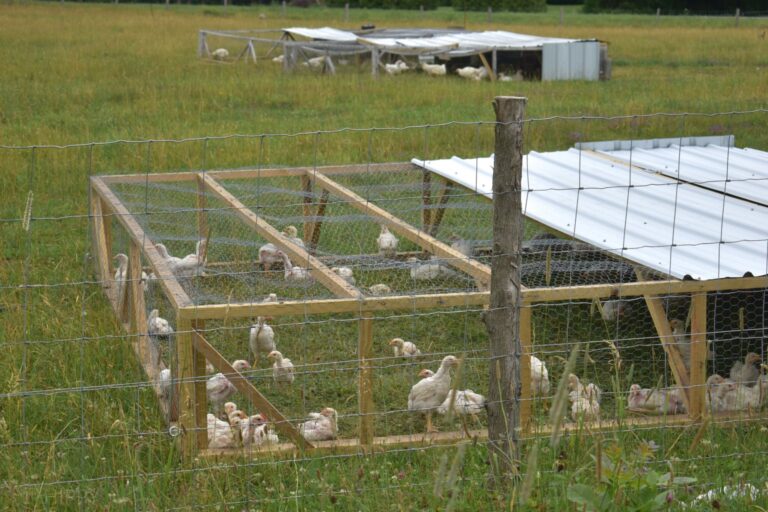
Tractor
Sadly, this isn’t a piece of farm equipment that birds can operate. A chicken tractor is essentially a mobile coop with an integrated run enclosure. If you want to split the difference between full-time run living and free-ranging, this is the design for you.
Tractors typically have two or sometimes four wheels, or sometimes many more in the case of huge industrial-sized tractors, that make them easy to push around. This isn’t just a convenience thing; chickens that stay in the run will soon deplete all of the insects, worms, and other critters and also obliterate the grass.
Moving the run around regularly stops that from happening, and it gives your chickens a somewhat new environment and view to enjoy.
Chicken tractors are another great choice for small to medium-sized flocks and one of the very best choices for folks who like to keep their property in tip-top shape. The ability to wheel the chicken coop completely out of the way when needed comes in really handy!
Converted
Converted coops are any coop that started life as something else: a shed, a playhouse, or even a sufficiently large crate. The most frugal chicken keepers tend to go this route, or folks who just want to bring their chickens home today and figure things out as they go.
Obviously, the features, pros, and cons of these coops vary dramatically based on what they started out as and how much care the owner put into them. Maybe not surprisingly, many of them need a lot of work to make them work: nesting boxes need to be installed, along with roost bars, ventilation provided, and openings shored up to stop critters from getting in.
Still, if you’re on a budget, almost anything that is sufficiently large and sturdy can be made to work if you’re willing to put in the sweat equity.
Bad Coop Designs
There are many ways to skin a cat and many ways to properly house chickens. But despite this, there are some coop types you should just avoid.
Run-In Shelter
A run-in shelter is a livestock shelter that is closed on three sides with a roof. The one side is open, hence the animals can just run in. That’s where it got the name.
Although fine for sheep, goats, cows, pigs, and other animals, these shelters are completely inadequate for chickens because they provide no protection from predators whatsoever and, in most environments, they don’t offer enough protection from the elements.
Don’t even try it.
Pallet-Wall
Building around the homestead with pallets is practically its own pastime. Pallets are plentiful, free or very cheap, and often made of surprisingly strong wood. You can do great things with them, including repurposing that wood to make a chicken coop, but what you shouldn’t do is make one out of stacked and nailed pallets alone as a rule of thumb.
Simply stated, they aren’t secure enough, no matter how sturdy you end up making them. Snakes, mice, and rats will invariably be able to sneak through the slats to get at your birds and chicks inside. Trusting such a structure to keep these predators at bay is basically serving up your birds on a silver platter.


Heather’s homesteading journey started in 2006, with baby steps: first, she got a few raised beds, some chickens, and rabbits. Over the years, she amassed a wealth of homesteading knowledge, knowledge that you can find in the articles of this blog.
Learn more about Heather and the rest of the writers on this page.
I love the homesteading life, my family and I have stepped up with growing some of our own food, raising rabbits, chickens and want to learn more.