
There’s no denying that chickens rule the roost when it comes to popular poultry. These yardbirds have an unbeatable combination of good health, high productivity, and easy care. But turkeys are increasingly turning up in the care of homesteaders, too!
Turkeys grow more slowly but provide far more delicious meat with a different flavor than chicken, and their eggs are truly delectable. Plus, turkeys are far less vulnerable to some predators.
Both species have their advantages, but some homesteaders don’t want to choose and instead seek to raise these birds together. Which begs the question: should they?
The good news is that it is possible and there are some good reasons to do so, but on the other hand, there are some reasons why you might decide against it.
I’ll tell you about the reasons for and against it in this article. Keep reading and we will get right into it…
Easier Care
Simply enough, when you get started raising either chickens or turkeys, it becomes easier to raise the others alongside them. You can consolidate chores like cleaning, feeding and watering, inspections, and so forth.
Plus, if you already have space set aside for one or the other, it’s much simpler to incorporate the requirements of the others rather than raise them completely separate from one another.
As homesteaders, we are always looking for ways to increase efficiency so we can get more done with less effort, and if both species of bird definitely appeal to you, this is a great way to do it.
Plus, you’ll usually be able to get the things both birds need from the same places. Food, medicine, supplements, and the like are readily available from specialty poultry retailers or brick-and-mortar suppliers.
That isn’t always the case if you’re raising chickens and other mammals, for instance.
They Generally Get Along
It might seem strange considering the size disparity between these two species, but chickens and turkeys usually get along pretty well.
Both birds are happy to keep to themselves even in a shared space, and as long as there are no squabbles over access to food and water, a lack of space, or problems brought on by aggressive toms or roosters, you can expect your feathered friends to live in harmony more or less.
You can expect even better relations if you only have hens between your flocks or only hen turkeys in a mixed flock of chickens. In my experience, those dynamics tend to work out the best, as they tend to be stoic, calm, and patient compared to the typically high-strung chickens of any given breed.
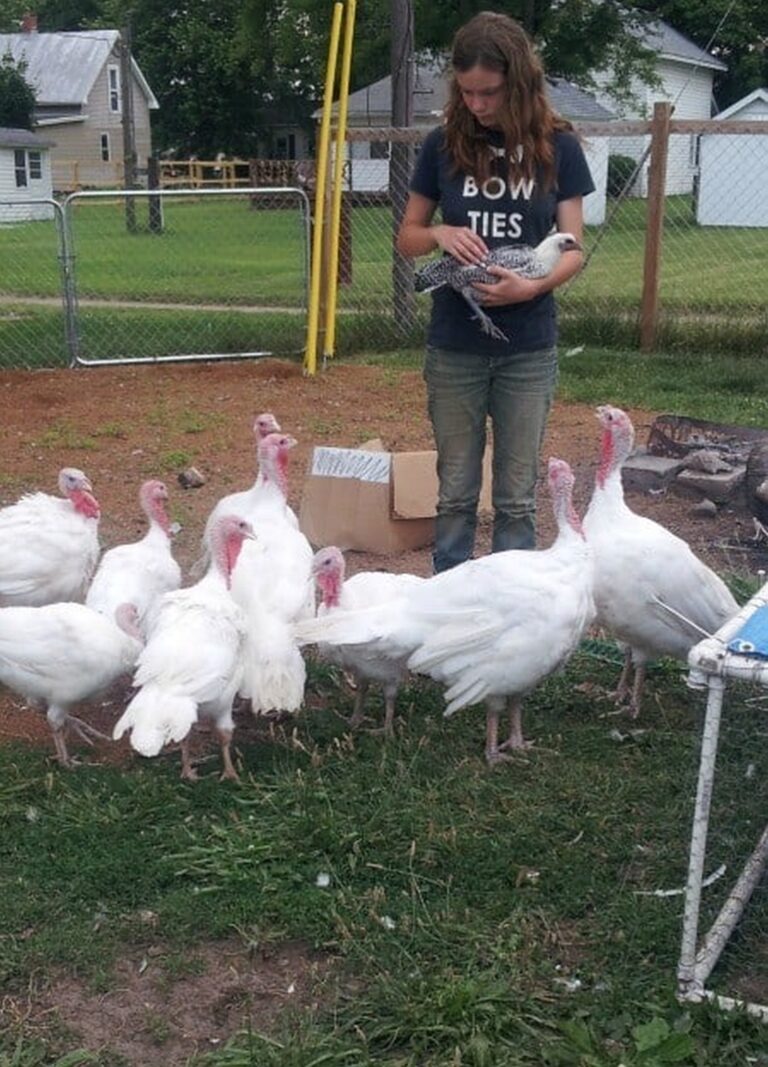
Turkey Hens Can Act as Peacekeepers in a Chicken Flock
Even better than just getting along, the presence of a turkey or two in the run or yard can squash squabbles that often crop up between chickens.
All birds that live in a flock environment establish a pecking order internally, figuring out who gets to eat and drink first, who gets prime roosting spots, and who generally just rules over the rest of the birds. Chickens are no different, and indeed are pretty notorious when it comes to pecking order scuffles.
Sometimes, though, chickens can actually have it out for one another for whatever reason. It might be a couple of hens that are vying for dominance somewhere in the middle or near the top of the hierarchy, or a rooster that is a bit too aggressive about keeping his charges in line.
Whatever the case, turkeys tend to keep a lid on this kind of activity and can make your job a whole lot easier.
I’ve seen my own turkey, a mature and sweet-natured hen, go from gentle and aloof to downright matriarchal when a couple of my chickens wouldn’t stop pecking and fussing at each other. When she charged in, the fight was over, and she didn’t have to lay a feather on the other birds!
As long as both species are used to one another, you can count on the big girls keeping the peace day to day.
Turkeys Can Ward Off Some Predators
You know by now that chickens are preyed on by just about everything, from coyotes, dogs, foxes, raccoons, skunks, and snakes to many birds of prey. Pretty much everything that eats meat loves the taste of chicken!
But jokes aside, this is a perennial, constant problem for poultry keepers. Keeping your chickens safe when they are inside the coop is one thing, but keeping them safe in the run or, even worse, when they are free-ranging is something else entirely.
Turkeys can really help out here because they can easily ward off some predators. Turkeys are big, heavy, powerful birds, and many of them weigh upwards of 15 pounds.
Their long claws and spurs, stout beaks, and far greater strength can make short work of smaller predators like rats and snakes, and birds of prey will probably be dissuaded from making a pass if they are nearby.
This protective presence extends over your chickens if you keep them together, and I can all but guarantee you’ll lose fewer chooks if you have a turkey around.
Large Hens Can Hatch Turkey Eggs
Turkey eggs are considerably larger than chicken eggs, but if you have a broody hen among your chickens you can rely on her to hatch them all the same—assuming she’s large enough!
Turkey eggs are about twice as large as chicken eggs, and this means that your average mature hen can sit on five or six of them and hatch them herself if you don’t want to go through the trouble of incubating them.
Unfortunately, this arrangement doesn’t work in reverse: turkeys are too big, too heavy, and comparatively too clumsy to even attempt to hatch chicken eggs. That’s only going to result in some busted eggs!
Chicks and Poults Can Grow Up Together
It’s a good thing for chicks and poults (young turkeys) to grow up alongside one another. It makes it far more likely that they will get along in adulthood, and you can continue to enjoy peaceful cohabitation of your flocks for generations.
However, you don’t want to raise chicks and poults together directly: chicks grow way faster than turkeys, reaching maturity in just 3 months or a little longer, and accordingly, they tend to bully and boss around young turkeys which can be surprisingly docile by comparison.
This only instills an attitude of competition in the chickens and creates enormous stress for the turkeys.
However, keeping them close by in their brooders, and even letting them see each other when they get to take forays outside is a good thing for both.
Chickens May Get Immunity to Marek’s Disease from Turkeys
One of the best and most unexpected benefits that come from keeping chickens and turkeys together is definitely one-sided in favor of the chickens, but a welcome one all the same.
It turns out that chickens can gain partial or even full immunity against the highly contagious, viral Marek’s disease from close association with turkeys. This is because turkeys carry a genetically related but harmless virus that will basically inoculate chickens naturally.
This disease is no joke and has devastating, chronic health implications for chickens. It can cause partial or sometimes even complete paralysis, neurological degradation, vision loss, and could even result in the widespread growth of cancer on a chicken’s internal organs.
Definitely bad news and it is made worse because it is extremely contagious and will rip through a flock rapidly.
There is no cure for this devastating poultry disease, though it can be vaccinated against. However, the virus can persist in the environment, including on surfaces, for years! You’ll have a lot less to worry about, at least for your chickens, if you keep a turkey alongside them.
5 Reasons Not to Keep Them Together
It isn’t all good news when it comes to raising chickens and turkeys together, and there are some definite and legitimate reasons why the practice should be avoided.
Ultimately, it’s up to you to decide what makes the most sense for you and your flocks or lifestyle. Definitely consider the following though.
Blackhead Disease Outbreaks
This is it. The most divisive factor when it comes to raising chickens and turkeys together. And honestly, it’s with good reason.
Blackhead disease, also known as histomoniasis, is caused by the protozoa Histomonas meleagridis. Chickens can contract it, but it is rarely severe for them. It is absolutely devastating, almost always fatal, for turkeys though…
The mortality rate is in excess of 80% and it is almost always lethal for poults. Low blood oxygen levels will cause the skin of a turkey, including their head, to redden and darken, hence the colloquial nickname of the affliction.
Symptoms include a lack of appetite and significant weight loss, listlessness, drooping wings, poor plumage condition, and bloody droppings. Cause of death usually results from attendant bacterial infection or liver failure, and death can strike very quickly.
Biosecurity protocols including the regular tilling of all ground where birds are kept, relentless control of worms and parasites, and proper disposal of waste can minimize – but not completely eliminate – the chances of blackhead disease.
Chickens are a strong contributing factor to turkeys catching it, and that’s why you might want to think twice before housing them together.
Both Species Have Different Nutritional Needs
Another consideration that can make your life tricky is the fact that turkeys and chickens have significantly different nutritional requirements. Now, right up front, if a chicken gets some turkey feed or a turkey gets some chicken feed it’s not going to hurt either bird. Don’t sweat that part.
The problem is that a turkey cannot live on chicken feed and a chicken cannot survive on turkey feed. Turkeys need a lot more protein and far more calories than chickens do, and chickens will get too much of both if they try to subsist on feed formulated for their larger cousins.
This problem is relatively easy to solve by using separate feeders and, of course, having the correct feed on hand for both birds. But keeping either out of the food meant for the other is easier said than done!
Chickens Might Hassle Toms
Male turkeys, called toms, are iconic for that giant fan of impressive tail feathers. They use those to woo the ladies, and boy are they impressive!
Apparently, they really impress the chickens too, enough to make them a little jealous. Enough that they tend to pick and peck at a tom’s tail feathers specifically.
It sounds funny, but this is no laughing matter. You can’t let chickens do this because when chickens see other chickens doing it, they imitate the behavior and join in. This is, obviously, going to stress the male turkey severely and it will eventually lead to retaliation.
Remember what I said about turkeys being so much bigger and stronger than chickens up above? Yeah, when this far bigger bird drops the hammer on a little chicken, the outcome is usually pretty awful.
You’ll have to stay on top of keeping your chickens from pestering your male turkeys if you have any, but that behavior can be hard to break and usually requires fitting the offending birds with blinders or treating the turkey’s tail with anti-peck ointment or spray.
They Usually Cannot Share a Coop
Just because the two birds can get along outside doesn’t mean they can properly cohabitate in a coop. The problem is simply one of size most of the time, but it might also be behavioral.
Turkeys are much, much larger than chickens and that means they need a much larger door than chickens do. Your chicken coop likely does not have such a door for the turkeys to use, which means you’ll need to modify it.
In any case, turkeys also need a larger, stronger, and thicker roosting bar (at least 4 inches in diameter), and they have a tendency to want to dominate the uppermost bars which can cause conflict with chickens that have a strictly ordained pecking order.
Between the lack of space and the other aforementioned problems, you are usually best off giving turkeys their own coop that meets their needs, or else building a duplex coop that has a dedicated space for the turkeys and a separate one for the chickens.
In either case, this is an aggravation and cost that I know most homesteaders would prefer to avoid.
Parasite Monitoring and Prevention Become Critical
Keeping turkeys and chickens together is going to expose both birds to new and novel parasites that they would be unlikely to encounter otherwise.
Especially considering the preponderance of lethal diseases like blackhead, this means that you must be on top of your game when it comes to testing birds and their poop for parasites and enacting control measures.
This is something that must always be done to properly care for poultry, but keeping these two species alongside each other complicates things and increases the workload.
Plus, properly treating foraging areas and the run to help reduce and eliminate fecal-borne parasites becomes even more important, and really the only way to do this reliably is to move the coop and then treat the land for a period of 6 months to 2 years in order to ensure a total die-off of parasites.
Again, this is a logistical problem that many folks, myself included, would just prefer not to deal with. You won’t have to deal with it nearly as often eiither if you’re only keeping one species or the other, not both, in the same place.
It’s not insurmountable, but definitely something you need be prepared for…


Tom has built and remodeled homes, generated his own electricity, grown his own food and more, all in quest of remaining as independent of society as possible. Now he shares his experiences and hard-earned lessons with readers around the country.
Find out more about the team here.