
Most of the time, baby goats are born to a doe that loves them and will care for them enough to feed them, but that doesn’t always happen.
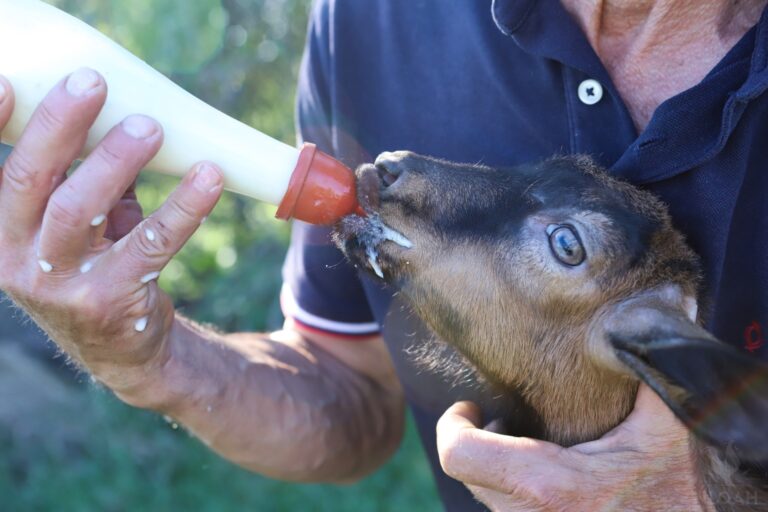
Sometimes, sadly, the mom, for whatever reason, won’t be able to take care of her little ones, and that means you’ll have to swoop in and save the day by bottle feeding the young kids.
It’s as adorable as it sounds, but make no mistake, this is serious business. Young goats have intense nutritional requirements that must be met.
Sometimes this responsibility will be thrust upon you, and you’ll have to step up to the challenge with no room for error because the little ones are counting on you!
Don’t panic, because I’m here to help with a complete guide covering everything you need to know to successfully bottle-feed baby goats. We will get right into it below.

Why Would You Bottle Feed a Baby Goat?
There are several circumstances when you might need to bottle feed a precious little baby goat.
As mentioned above, though it’s true that their mother will usually take good care of them and make sure they get plenty of milk when they need it, sometimes things go wrong.
Does can die unexpectedly, leaving the kids orphaned. In the case of multiple kids, she might well reject one or more and prevent them from feeding.
Sometimes the kid itself is too weak or sickly to feed, and will need your direct intervention to save it. And, every now and then, you might want to deliberately raise a bottle baby…
Bottle-raised kids are invariably much sweeter, friendlier, and far more interested in people, and this can be the ideal approach if you want a genuine pet goat. They’ll always look forward to seeing you for the rest of their lives if you bottle-raise them!
Plus, not for nothing, it’s a great way to bond and spend time with them when they are young, even if it is a lot of work.
And keep in mind, if you don’t have these skills and a kid suddenly requires bottle-feeding with no other options, their life will be in danger! Every responsible goat owner should know how to bottle feed baby goats; plan accordingly.
Milk Options for Baby Goats
The first thing to talk about is what to actually feed them. I know, cold milk, right? Yes, but there’s more to it than that….
For starters, newborn goats need more than just milk, and actual, fresh goat milk might not always be available. You need to know what your best options are and what your alternate options are. See below.
Colostrum
All newborn goats must have colostrum during their very first day of life. This special nutrient and antibody-rich milk is naturally produced by does, and will be the first thing that her young will eat.
Kids that don’t get it will usually die, and if they do live, they will be sick and suffer from stunted growth.
It’s imperative that you have enough on hand to get a newborn goat through their first day of life, and this will be anywhere from 4 to 8 oz or a little more. If the kid’s mother is still alive, you can get it directly from her and put it in a bottle for feeding to the newborn immediately.
Otherwise, you’ll need to get it from another pregnant doe or use a specialty colostrum replacer, though these are not as good as the real thing.
Here’s a pro tip: if you’re thinking you’ll be breeding more goats in the future, you can save colostrum and freeze it for future use. This ensures you’ll always have the good stuff on hand in an emergency!
Fresh Goat’s Milk
Young goats need goat’s milk, of course! If you have lactating does to milk, you can simply milk them, immediately transfer this milk into a bottle, and then feed your hungry babies.
Note that if you haven’t been testing your goats for CAE or other communicable diseases prior to this point, or if you are getting milk from a neighbor’s herd or some other source, it’s a good idea to heat-treat the milk to eliminate all risks of infection.
Keeping goat’s milk at 161°F / 71°C for 30 seconds will pasteurize it. Then you can just let it cool to skin temperature before bottling and feeding.
Cow’s Milk
Believe it or not, baby goats can do pretty well on cow’s milk in a pinch, though goat’s milk is always best. If you have any cows on your homestead, or if your neighbors do, and they are in milk, you can feed your kids cow milk with good success.
If you don’t have a cow, or your cow is not in milk, you can buy whole milk from the grocery store, warm it up, and use that. If possible, try not to make a habit of it and get your kid onto goat’s milk as soon as possible.
Milk Replacer
Your last option for bottle feeding kids is goat milk replacer. This is basically baby formula for goats and typically comes in the form of a concentrated powder or sometimes a liquid. You’ll have to read the package instructions for mixing or thinning it.
Milk replacer is certainly viable but has a bad reputation in many quarters for causing indigestion, and often you’ll need to follow the feeding schedule of the product instead of the generic but reliable feeding schedule I’ll share with you in a few sections.
Under no conditions should you mix up milk replacer without consulting the instructions! Making it too rich can easily give baby goats diarrhea and cause subsequent dehydration, which can be fatal.
Bottle and Nipple Options
Now that we know what we’re going to feed our little ones, we need something to feed it to them with.
Here you have a few options, and all are viable, and I actually recommend you have at least two of them on hand in case you are dealing with a stubborn kid.
Pritchard Nipple
One of the most common and recognizable bottle nipples for feeding baby goats. Easily identified from their bulbous, red tip. This is a medium-sized nipple that is designed to fit on a variety of bottles with common, coarse thread patterns.
I know plenty of goat herders that keep 1-liter and 2-liter juice and soft drink bottles on hand for use with these nipples, and they work wonderfully.
Note that with the pritchard nipple, you’ll have to carefully cut open the very tip to make an opening for the milk to flow through.
Lamb Nipple
Lamb nipples are exactly what they sound like, bottle nipples that are designed for feeding baby lambs. They are shorter and thicker compared to Pritchard nipples, but some kids prefer them.
Most varieties will also fit on common bottle threads just like the Pritchard nipples, meaning they are a good choice if you want to reuse and repurpose drink bottles that you would throw out otherwise.
Baby Bottle
Don’t laugh; they work pretty well. Despite assertions to the contrary, baby bottle nipples are not too small for young goats to drink from, and for stubborn or picky sucklers particularly, I found great success with them, as have some of my neighbors.
If you have a little one that is just plain resistant to either the lamb or Pritchard nipples, give a conventional baby bottle a try.
How Much to Feed Them
Baby goats have particular nutritional and caloric requirements, and you should try to fulfill them as closely as possible without giving them too much to drink.
The temptation is to give a precious baby goat as much milk as it wants in every sitting. Don’t Do This!
If you do, it’s a certainty that they will get scours (diarrhea), and that will lead to major dehydration as mentioned before.
Worse, they might suffer from bloat or enterotoxemia, and at this tender stage of life either can be fatal. Regardless, it’s not something you want to deal with or want to put them through…
The solution, then, is to carefully measure out how much milk you are giving them at each feeding and give them that much and no more, no matter how much they beg. As they age and put on weight, you will increase the serving size and decrease the frequency of feedings.
The table below will tell you everything you need to know to feed most breeds:
| Age of Kid | Milk Per Feeding* | Feedings Per Day |
|---|---|---|
| 1 Day | Colostrum, 10% of body weight | As many as needed to reach target. |
| 2 – 10 Days | 4 – 6 ounces | 4 – 5 |
| 11 – 21 Days | 7 – 12 ounces | 3 – 4 |
| 21 – 42 Days | 12 – 16 ounces | 3 |
| 43 – 60 Days | 16 ounces | 2 |
| 61 – 90 Days | 16 ounces | 1 |
*For dwarf or pygmy breeds, reduce the amount per feeding by 25%.
Provide Water and Creep Feed, Too
Starting between days 2 and 5, make sure they have hay and water available constantly.
They probably won’t eat or drink very much, and they will get pretty much all of their nutrition from their milk. But the sooner they start having a little hay and water, the easier it will be to wean them later.
Keep an eye on them in between feedings and see if they’re showing any interest in solid food. If they are, that’s a good sign, especially moving into week two…
Proper Feeding Positions
Okay, now we’re getting down to business. This is either the fun part or the frustrating part, depending on your proclivities and the attitude of your goat.
You’ll want to make an effort to feed your kids in the same place and in the same way every time. Consistency will make them feel comfortable and also make them drink more readily. Try the following…
In Lap
For small, weak goats that are already suffering from compromised health or just like the emotional encouragement of close contact, lap feeding is often best. It requires less effort from the goat, and who doesn’t love snuggling with these little cutie pies?
It can also make it easier for you to properly position the goat and hold up their head if they need help. Just make sure they can’t slip out of your lap and fall.
Standing
This is the position that babies usually drink in. Mom will be standing, they will be standing under her, and sucking on the teat.
If you don’t want to mess with keeping the goat in your lap, there’s nothing wrong with making them stand to drink assuming they are able to do so.
Getting Baby Goats to Drink
Okay, so you know everything you need to know from the type of milk you are giving them to how much, what kind of bottle, and the best position. So how do you actually get the little critter to latch on and start drinking? It kind of depends…
Strong, eager goats will often find the nipple themselves and start chewing or suckling. Chewing is counterproductive, but given time they usually figure out that they should suck rather than chew.
If your goats are showing interest in the nipple and just don’t seem to know how to take it from there, gently open their mouth with two fingers and splash just a few drops on their tongue. They’ll usually figure it out quickly enough from there.
From here, all you need to do is hold the bottle in position and they will handle the rest.
Remember that you should have measured out the portion of milk, and you always want to err on the side of them being a little hungry versus being overfed. If they let go of the nipple more than once, assume they are done drinking.
Dealing With Resistant Kids
Sometimes, for whatever reason, you’ll deal with a kid that either can’t or won’t latch and drink, or do so reliably.
This can be a frustrating and indeed hair-raising time because you might see the little thing getting weaker and weaker as time goes on, and feel powerless to give them the milk they desperately need.
Don’t panic, but do take action. The following tips will help you get a reluctant or nervous bottle baby to drink regularly…
Be Calm, Don’t Freak Out
The golden rule of bottle feeding a baby goat. If you are calm, they will be calm. If you freak out, they will freak out. If you are tense and stressed, so too will they be.
This sounds elementary, and it is, but when emotions are running high it’s easy to get tense even though you care and want to help. Be calm, be pleasant, pet the kid, and talk sweetly to them to help them stay calm and they are much more likely to drink their fill.
Give Them a Taste
If your kid won’t even take the nipple in their mouth, you’ll need to force-feed them—but gently! Using one hand, carefully pry open their jaws and then insert the nipple into their mouth before dribbling out a little bit of milk on their tongue or in their cheek.
Remove the nipple and your hands and let them lap it up. Repeat this process if you have to, but be cautious not to flood their mouth with milk because that could cause them to aspirate.
Once they have a few good swallows, they will usually lighten up and show more interest in the bottle.
Check Milk Temp
You should be feeding baby goats milk that is skin temperature, not hot, not cool or cold.
You can check the temperature of their milk the same way you would for a human baby by putting a little bit on the inside of your arm. If it feels truly neutral, it is good. Remember that people might enjoy an ice-cold glass of milk, but animals definitely do not!
If any of your babies seem reluctant to drink, especially if they’ve been drinking readily to this point, check that temperature. Warm it up gently if required, or let it cool off if it gets too warm and then try again.
Try a Different Position
It’s possible that your baby might simply be uncomfortable in their current feeding position. If they usually feed in your lap, set them down and make them stand up. If they usually stand, try putting them in your lap.
Also, adjust the angle and height of the bottle. Near vertical usually works quite well and is closest to nature, but a little adjustment might be required.
Change Nipples
Sometimes, there’s nothing for it. Your precious friend might simply hate the nipple you’ve got on your current bottle.
Try changing out nipples and then trying again after you give them a little taste of milk. This is why I strongly advocate owners have at least two different types of nipples on hand.
Try a Coffee Rub!
This is an old timer’s trick that works really well for encouraging weak or recovering goats to drink. Brew a little bit of coffee, let it cool down, and then dip your fingers in the coffee before rubbing it on the gums of your goats.
This tiny jolt of caffeine is usually enough to give them energy and appetite enough to start suckling on the bottle.
Weaning Bottle Babies Off the Nipple
Baby goats love milk and will drink as much as you care to give them, even right into adulthood! However, the time will always come to wean them off of the bottle. The question is when you should do so.
It’s possible to wean a kid off of the bottle as early as 30 days if you force them to drink water and eat solid food, but in my opinion, this is really pushing it.
Most veterinary guidelines recommend keeping them fully on bottle feeding, and creep feeding them as previously discussed, until they are between 6 and 8 weeks old.
You might decide to bottle feed a kid until they are 12 weeks old, and there’s nothing wrong with that: keeping them on the bottle that long will often produce an adult goat that is supremely friendly and sweet with people!

If you’ve got the time and are willing to put in the effort, you might consider doing so for your favorite goat or a genuine pet.
Tim is a farm boy with vast experience on homesteads, and with survival and prepping. He lives a self-reliant lifestyle along with his aging mother in a quiet and very conservative little town in Ohio. He teaches folks about security, prepping and self-sufficiency not just through his witty writing, but also in person.
Find out more about Tim and the rest of the crew here.