
Pigs can be a great choice of livestock animal for your homestead. They’re smaller and easier to keep compared to cows and horses, and can keep you, your family, and your neighbors stocked up on delicious bacon and pork chops, or form the core of a profitable business.
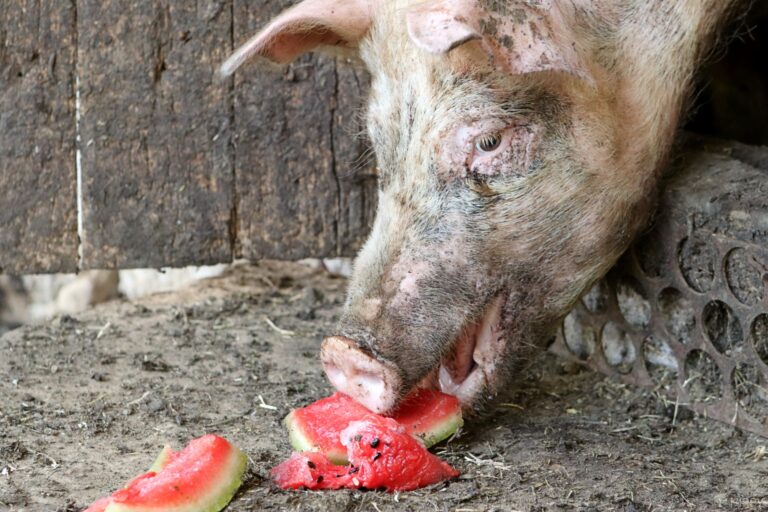
Pigs also tend to be healthy and happy animals, and they can be a lot of fun besides. However, pigs have their own unique challenges associated with them…
I’ve talked to dozens of folks who decided to bootstrap themselves into raising pork, only to make painful and expensive mistakes all along the way. And take it from me, because I was one of them once upon a time!
You don’t have to be born into pig farming to successfully raise them, but you’ll have a much easier time of things if you follow these 8 pro pieces of advice.
Place Your Pigs as Far from Your House as You Can
I hope this would be obvious to most folks! If you have any choice, it’s best to create the pen or other enclosure for your pigs as far from your house as is practical, and preferably downwind of it.
Pigs stink, after all, and especially if you aren’t keeping up with waste disposal, they can stink horribly. Naturally, you’d probably prefer not to be smelling that awful odor all day and all night! Using a “no-odor” pen design and deep litter ground cover can help, but ultimately there is no getting around the fact that keeping pigs will always entail an aroma!
Keeping the pen far away won’t always be achievable depending on the size and shape of your property, but spending just a little time figuring out where best to situate your herd will help keep you and your family sane.
Your Life Will Be Easier if Pigs Have More Space
If you spend any amount of time doing homework on pigs prior to bringing them home, you’ve probably seen surprising facts concerning how much space they need. As little as 8 to 10 square feet per adult pig is all that is strictly required!
Amazing! So you can just keep them in a small backyard, right? Not exactly…
If you keep them in that small a space, they will barely have room to turn around, and being crammed into close quarters, like you normally find on a factory farm, is going to make them irritable, more prone to illness and other health problems, and also create serious hygiene concerns from waste accumulation.
Your herd will always be happier and healthier if they have more room to roam, explore, and exercise. This will help prevent boredom and that will help prevent stress, translating into better gains.
Also, hogs will naturally try to go to the bathroom in one spot, all of them, if they have enough room, so that’s another reason why you want to give them more space.
A good rule of thumb is to give your pigs 80 square feet to themselves, per adult, in a fenced enclosure or paddock. If they’re allowed to roam your fenced property, a good guideline is to stock up to three adults for every quarter acre they have available.
Make Sure Your Fencing is Up to the Task
The most common mistake I see new pig owners commit is either cheaping out on fencing or not upgrading. Listen to me: welded wire and even woven wire simply aren’t going to do it for keeping your pigs in place.
If you want to cheap out with either, breakouts are a certainty. Pigs are strong, smart, and will exploit any opening or weakness to get out – and that means you’re going to be burning plenty of calories chasing after them.
Far and away your best choices for pig fencing are to go with specialty pig panels, built strong enough with openings small enough to keep any pig in place, or electric fencing.
Electric fencing is even better because it gives pigs a strong psychological incentive to stay away from it and not test it.
But you got to keep an eye out on the little porkers: I’ve watched pigs find low spots beneath the bottom wire and belly crawl under it without getting zapped!
You always have to be on your toes for escapes when keeping pigs… but you can keep those to a minimum if you put in the time to sort out your fencing before they arrive.

Provide Shelter Before They “Need” It
Something else you should sort out before you actually bring your pigs home is a shelter for them. They don’t need a giant barn or anything like that, but they’ve got to have shade from intense sunlight and somewhere to go when it is raining or very cold out.
For most folks, especially those who are only going to raise pigs until they are the proper market weight for slaughter, a three-sided shelter, often referred to as a run-in shelter, is fine.
Ideally, the shelter will be large enough to give each adult pig about 7 to 8 square feet of space inside. That much is adequate on a temporary basis, but not ideal for their long-term health and wellness: your pigs will far much better if not kept in such close confines for their entire life.
Like everything else, the shelter must be sturdily constructed to survive the attention of your herd: pigs can and will knock boards out of flimsy shelters, tear off siding, and commit a whole lot more mayhem.
Cultivate Relationships with Discount/Free Food Suppliers
Pigs eat tons of food. And I do mean tons! Plenty of starry-eyed owners find out quickly that their food budget doubled or even tripled based on the requirements of their herd.
Take another tip from me and avoid the financial shock by cultivating relationships early with food suppliers that can hook you up with stuff your pigs will love, and get good nutrition from, for pennies on the dollar or even free.
Bakeries, granaries, nearby farmers, restaurants, grocery stores, and, sometimes, even breweries can provide grains, vegetables, fruit, and a lot more that can radically improve your bottom line.
Usually, you’ll have to help them out or make things easy for them by picking it up on a certain schedule or by a certain time, but it’s well worth it.
Don’t forget that it’s possible to incentivize small businesses by offering them some of your forthcoming pork products. Who says ‘no’ to a few pounds of mouth-watering pork chops or bacon?
Make Sure Their Water Source is Pig-Proof
You know how I said several times already that pigs are very hard on their surroundings? That includes their water source. A bucket, bowl, or tray is just not going to cut it, and neither will a lightweight plastic trough or waterer.
Once again, you’ll have to go heavy-duty. An in-ground or partially in-ground trough made of heavy wood, metal, or potentially even concrete is just the ticket. Anything that is light enough for pigs to flip over, throw around, or chew on will be destroyed in very short order.
This is another item that you simply mustn’t skimp out on. If you do, the chances that your pigs will be going without water and start dehydrating are just too high, and in the end, you’ll be working a lot harder than you must to bring them refills.
Make an Appointment with Your Processor Early
Here’s a pro tip that is all too easy for beginners to simply not consider. Assuming that you aren’t slaughtering your pigs yourself, you’ve got to book an appointment with your processor early. How early? As early as possible!
There’s no such thing as too early, especially in pig country where lots of folks raise them. Make that call and get them on the schedule as soon as you have a good projection date for when your pigs will be at the ideal weight for slaughter.
For the vast majority of hogs, this will be between 250 and 325 lbs, a benchmark typically attained between five and seven months of age. Plan and book accordingly!
Remove Likely Hazards from Their Space
Pigs are smart. They really are. I know they have a reputation for being dumb, but they’re highly intelligent and capable of learning commands and figuring out clever solutions to problems.
Despite this, they are still just animals, and like all animals, they’ll do things that are against their best interests. They’ll chew on and eat wood, swallow washers, nails, wire, and other toxic or dangerous materials, and hurt themselves in all sorts of other creative ways…
Because of this, it is imperative that you perform a thorough sweep of their environment and remove anything that could hurt them or be harmful if ingested.
Old tires, leftover pallets, rusty fencing, a disused wheelbarrow, anything: given time and boredom, pigs will take an unhealthy interest in it, chew on it, and hurt themselves.
It will be a chore if you live on a hard-working homestead with lots of clutter lying around, but it must be done.

Tim is a farm boy with vast experience on homesteads, and with survival and prepping. He lives a self-reliant lifestyle along with his aging mother in a quiet and very conservative little town in Ohio. He teaches folks about security, prepping and self-sufficiency not just through his witty writing, but also in person.
Find out more about Tim and the rest of the crew here.